|
More than 100 years have been passed since this statement and it is amazing how many of today’s Egyptian breeders in Europe and America are still making the same mistakes. More than that, it seems that they deliberately ignore this old cognition. Many of today’s Egyptian horses have even a higher in-breeding coefficient than the horses 80 or 100 years ago.
|
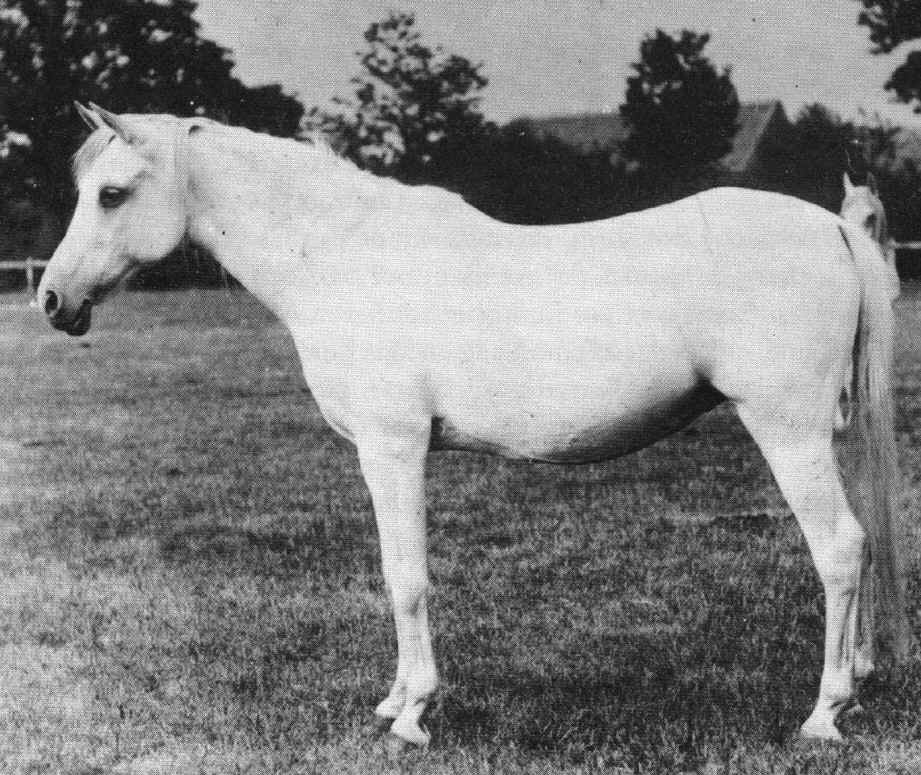
right: The Egyptian mare Sohba, which was purchased by Lady in 1891. The mare represents the classical type ot the Abbas Pasha horses at that time. The mare has a very good eye deeply placed, distinct jowls, a rather long head with a muzzle, which could be a little finer. Further characteristics are a long very good placed neck and distinct withers. The back is somewhat long with a strong and long croup, which slightly drops down. The legs are correct with deeply placed hocks. All in all an excellent mare representing the type of a riding horse. Where do we find this type of horses today? On shows you can't see them anymore and if they would be presented there, they wouldn't placed first. |
|
But beside a negative there is always a positive side. Due to this intensive line and inbreeding during several generations a special and very dominant Arabian type has probably been formed and crystallized. It is this fascinating and unique type, which demonstrates its penetrating power when crossbreeding Egyptian horses to other Arabian lines.
|
 left:
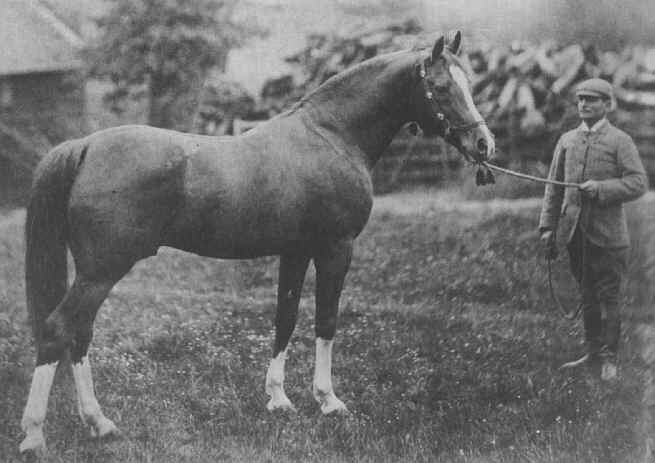
Mesaoud , purchased by Lady Ann Blunt in Egypt 1889. This stallion was one of
the most influential Egyptian sires of his time. left:
Mesaoud , purchased by Lady Ann Blunt in Egypt 1889. This stallion was one of
the most influential Egyptian sires of his time.
He is characterized by a short strong body with a lot of depth in breast and loins. His neck is very powerful and well formed and passes over in a excellent wither and shoulder. His head is straight and in good proportion to his body and his eye is rather placed highly. Although this stallion is genetically about 100 years closer to the original Arabian horse, he doesn't represent anymore the Arabian type requested by today's show breeders. Quite a few of today's Egyptian horse breeders would easaly classify him as a "French racing horse" . |
|
But fortunately I have to mention that there exist of course still today breeders of straight Egyptian horses, which develop their breeding programs very wisely and with a careful focus on the long sight. Some of them are trying very hard to enlarge the genetic pool through the effective exchange of stallions across continents. A very good example of a successful long term breeding program in Egypt itself is Albadeia Stud of Dr. Nasr Marei, who succeeds to develop the Egyptian horse on an evolutionary basis. (More about this breeding program in part II of this report).
|
 right:
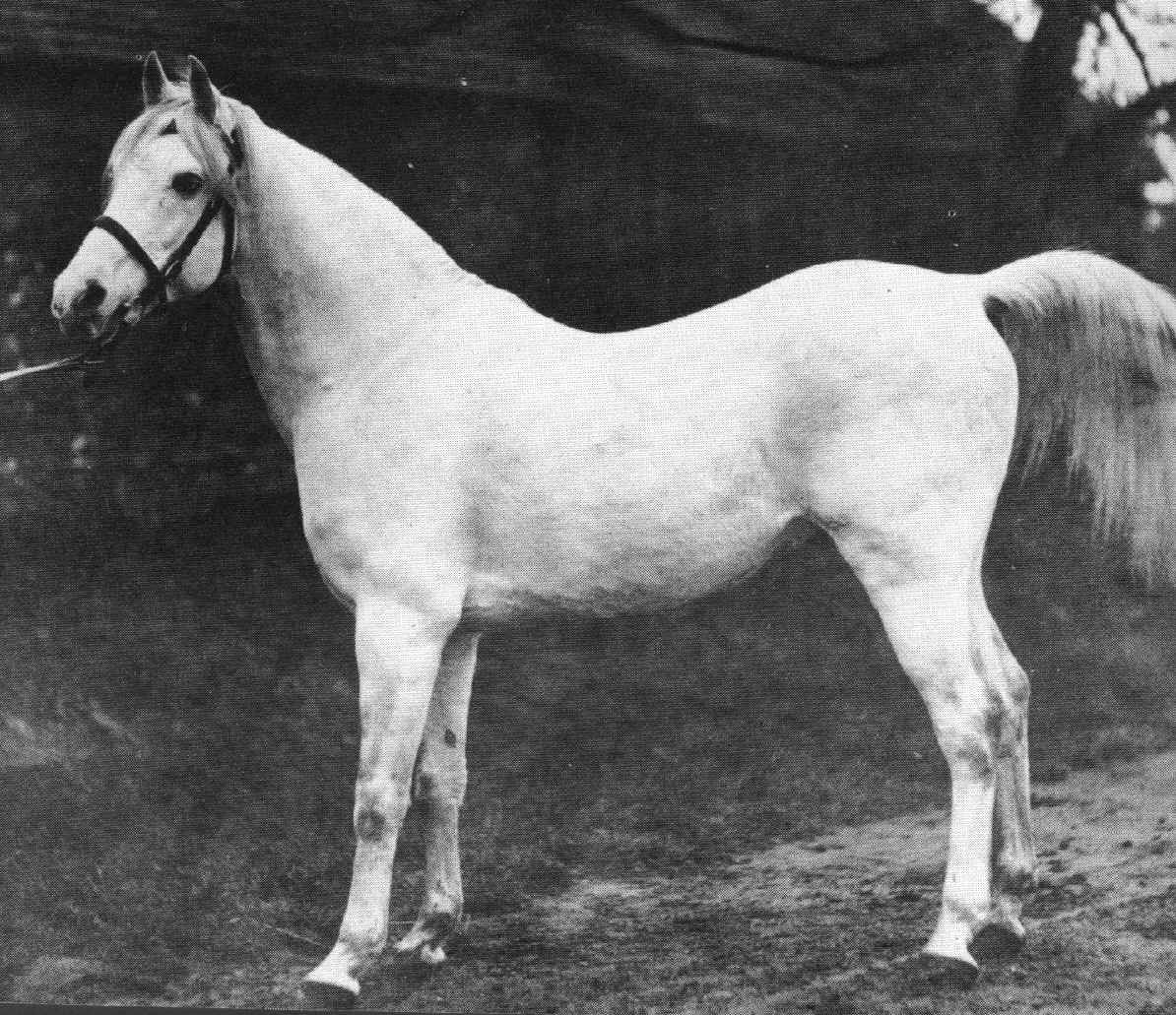
Shahwan is an Egyptian stallion in the unmistakable "Abbas Pasha
look". He was imported to England by Lady Anne Blunt in 1892. right:
Shahwan is an Egyptian stallion in the unmistakable "Abbas Pasha
look". He was imported to England by Lady Anne Blunt in 1892.
Shahwan is a strongly built and harmonic stallion in the shape of a quadrat. His head seems to be rather a little heavy with a somewhat highly placed eye and small ears. He has outstanding legs with smooth muscles and very short and large cannons. The hocks are deeply placed, large and flat with a smooth transition into the cannons. In spite of his Egyptian pedigree and his original Arabian tpye this stallion wouldn't win on Arabian horse shows of today.
|
| next page |
| back to news |